
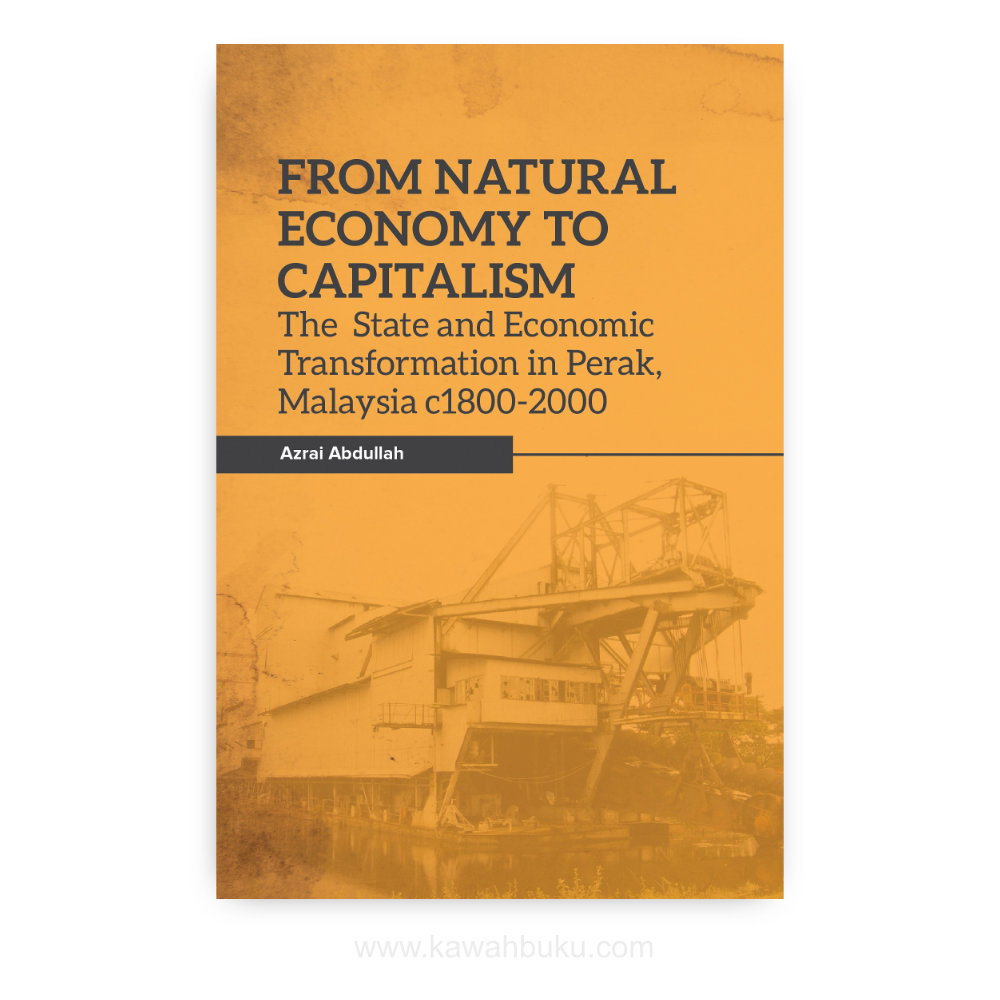
From Natural Economy to Capitalism: The State and Economic Transformation in Perak, Malaysia c1800-2000 focuses on transforming Perak’s economy from a precapitalist or ‘natural’ one to a modern post-colonial capitalist system. Perak saw the first formal external intervention of European power and the subsequent imposition of a British colonial administration which was later extended to cover the whole of Malaya (later Malaysia). The history of pre-colonial, colonial and post-colonial Malay(si)a has witnessed the state’s increasing involvement in economic affairs. Through the production and export of many sought-after commodities, mainly tin and rubber, Perak was increasingly incorporated into the world economy. The pre-capitalist system of production was slowly undermined and replaced by the capitalist system of production.
Nonetheless, Perak progressed at a much faster pace than any other territory in the country. Post-colonial national economic progress has seen different economic approaches undertaken in Malaysia, from the market-led approach in the 1950s and 1960s to a mixed market regulatory policy from the 1970s and then to a state-centred strategy increasingly from the 1980s, including economic diversification and industrialisation. During the period of independence, other Malaysian states have managed to challenge Perak’s dominance. Perak’s economic position has declined due to several factors, including the adoption of policies of industrialisation and modernisation, which have favoured other states, particularly Selangor and Penang, the move away from a resource-based economy, and the responses to changes in the world economy. The changes in these patterns of economic activities require examination and explanation to understand the relations between state intervention and the economy in Perak in the context of changes in the global economy.
This book, therefore, traces Perak’s economic development path from the pre-colonial era through the colonial period to the present. The changing mode of production, where capita! accumulation increasingly took centre stage, bad other structural implications for society. These changes, which were the consequence of Western European capitalist expansion, were made possible by establishing a global market and different forms of colonial intervention.



Reviews
There are no reviews yet