
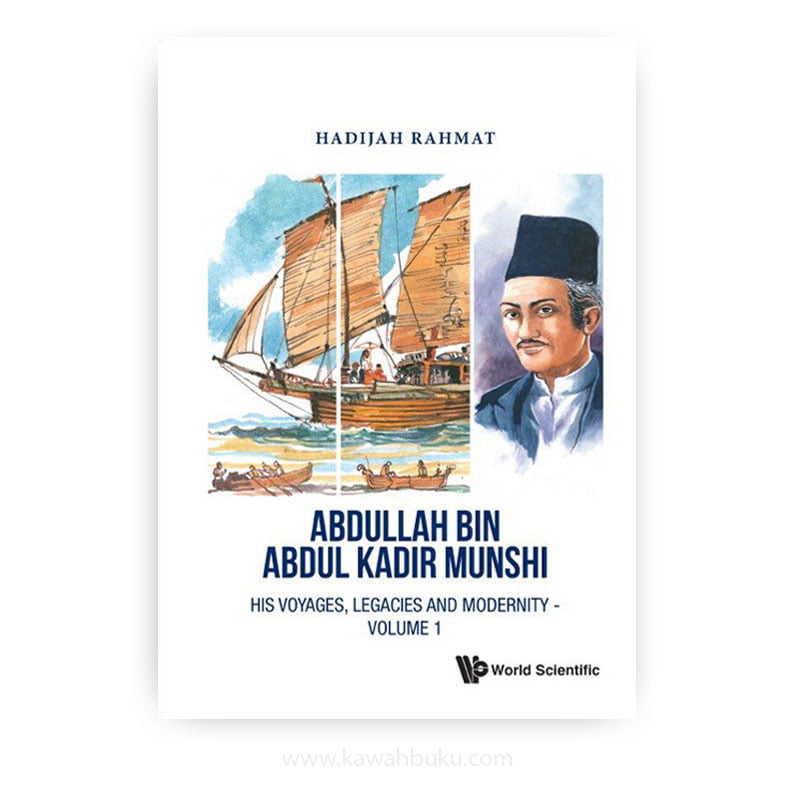
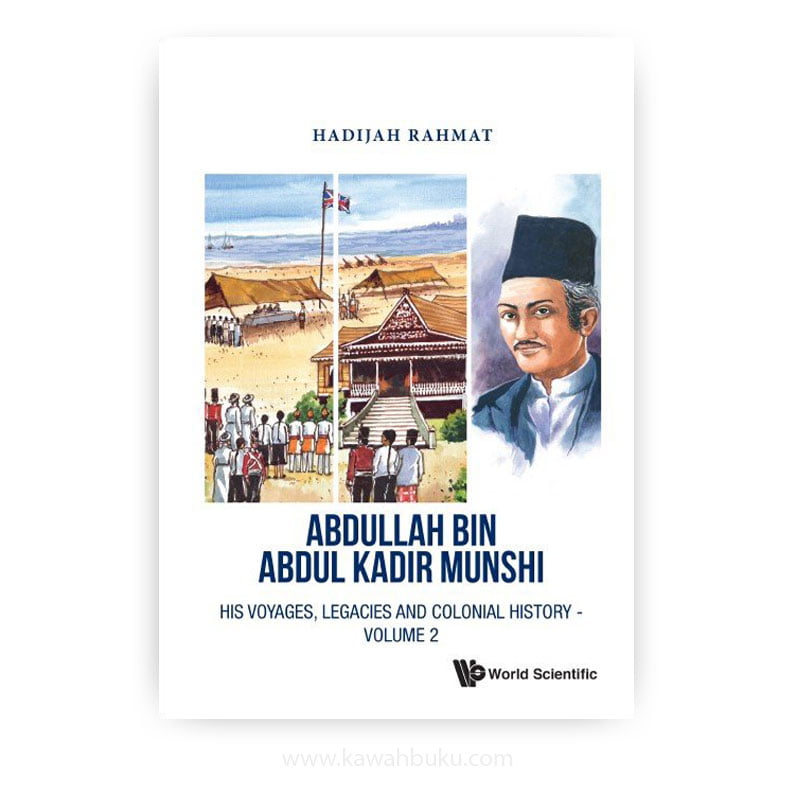
This book, Abdullah bin Abdul Kadir Munshi is the most comprehensive, multi-disciplinary studies on Abdullah bin Abdul Kadir, widely known as Munshi Abdullah (1796–1854). He was a prominent literary figure and thinker in the Malay world in the 19th century and was also an early ‘pioneer’ of Singapore. The author, Hadijah Rahmat, has spent more than 25 years studying Munshi Abdullah since her PhD studies in the School of Oriental and African Studies (SOAS), University of London, in 1992 to date. This book is covered in two volumes and is based on her research conducted using unexplored primary sources at several missionaries’ archives at SOAS, London, Houghton Library, University Harvard, Library of Congress, Leiden University, KITVL, Holland, and the Perpustakaan Nasional Indonesia, Jakarta.
The book consists of numerous academic papers presented at the regional and international seminars, and also published in international journals and as chapters of books. Besides academic papers, the excerpt of play titled Munsyi, sketches, poetry, and song, and interviews by the national media are also included. This book provides new insight into Abdullah’s life, backgrounds, writings, his influences and legacies and the reactions and thought-provoking views of the western and eastern scholars on Abdullah. The book is indeed the key reference for studies on Munshi Abdullah, Malay literature, and the history of Singapore, Malaysia, and colonialism in Southeast Asia.
Munshi Abdullah is widely known as the “Father of Modern Malay literature” and the pioneer of Malay printing for being the first local to learn about the printing technology in 1816. He was also a distinguished language teacher, interpreter, editor, and social critic. His two masterpieces are his autobiography, Hikayat Abdullah, and his travelogue, Kisah Pelayaran Abdullah. His other works include historial syair (poems) about Singapore, Syair Singapura Terbakar and Syair Kampung Gelam Terbakar. Abdullah was regarded as a respectable Malay scholar and language teacher for numerous high-ranking colonial officers such as Sir Stamford Raffles, Richard James Wilkinson, and Olaf Richard Winstedt, as well as a translator for Christian missionaries and European merchants. William John Butterworth, the Governor of the Straits Settlements (1843–1855), described Abdullah as “one of the most accomplished Native Malayan Scholars in the Straits” and “that most respectable native gentleman.”
Abdullah was born in Kampung Pali (Kampung Ketek) in Melaka circa 1796, approximately eight months after the East India Company (EIC) took over Malacca from the Dutch. Abdullah was of Jawi Peranakan heritage, that is to say, a local-born Muslim of Indian-Arab lineage. His great-grandfather was an Arab from the Uthmani community (“bangsanya ‘Uthmani’”), who migrated from Yemen in the southern Saudi Peninsula to Nagur, India.




Reviews
There are no reviews yet