
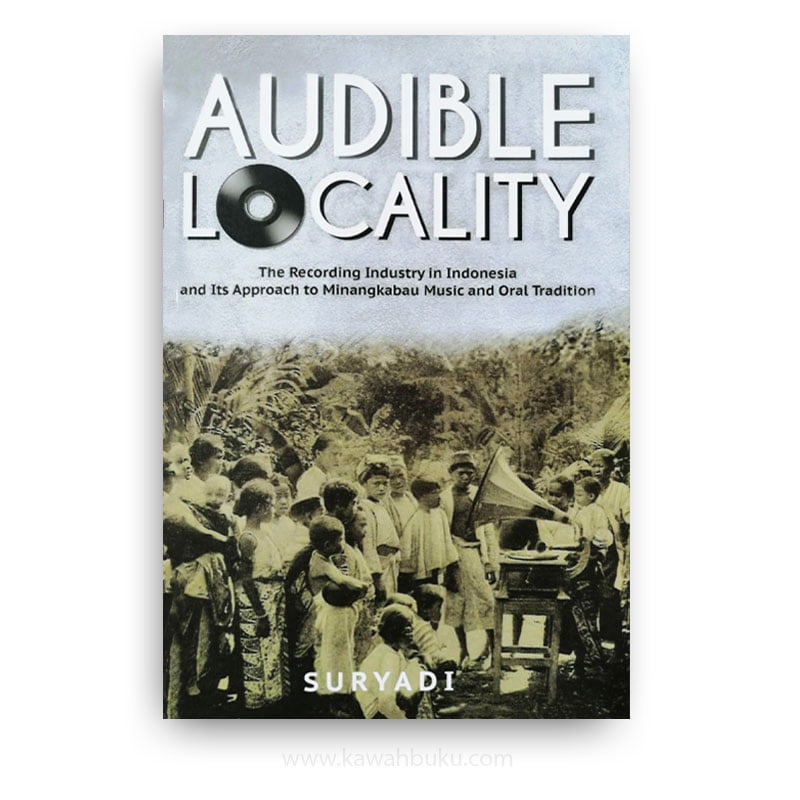
Audible Locality: The Recording Industry in Indonesia and Its Approach to Minangkabau Music and Oral Tradition is the first thorough study on the cultural ramifications of recording technology on ethnic sensibility in Southeast Asia. Exploring chronologically the representation of Indonesia’s regional culture through recording media, it recounts the Dutch East Indies colonial society’s initial encounter with such media and the local adoption and social uses of various types of it among the Minangkabau of West Sumatra and their diaspora.
Audible Locality is a study in a diachronic perspective on the impact of recording technologies, more specifically cassette and video compact disc (VCD), on Indonesian local cultures and societies. It examines how modern reproduced sound, which is constantly proliferating and multiplying up to today through various (social) media, but initially facilitated by recording media technology through the agency of regional recording industries, has influenced the contours of Indonesian local cultures. The book relates Indonesia’s first encounter with recording technology, examines the nature and cultural ramifications of the expansion of recording technology among Indonesia’s ethnic groups, and looks at its engagement with other media. As a case study, the West Sumatran recording industry is explored, along with the commercial cassettes and VCDSs it has produced. The author examines the features, content, and socio-cultural meanings of mediated Minangkabau cultural expressions.
In this study, the author’s starting point is a local perspective rather than a metropolitan one. The author focus attention on the outskirts of the nation: West Sumatra in the western part of Indonesia, a province inhabited mostly by the Minangkabau ethnic group. Exploring the use and consumption of recording media in this Indonesian regional context and its effects on local culture and ethnicity, the study approaches the topic from the perspective of the region. The author uses the term ethnicity in this book, among various understandings and theories about it, to refer to ‘the social construction of descent and culture, the social mobilization of descent and culture, and the meanings and implications of classification systems built around them’.
Ethnicity is a highly elastic concept applied to groups who say they share or are perceived to share some combination of cultural, historical, racial, religious, dress, food, or linguistic features and also ancestral origins, by which the connection between its members is not conceived as a familial bond. Of those elements, ‘common descent and shared origin are central’. By applying such a region-centric perspective, this study provides a view of the multi-faceted and heterogeneous character of Indonesia’s media industries, specifically its regional recording industries, thus complementing the predominantly national and metropolitan-centred approach of studies of Indonesia media and culture.
Indonesia’s regional recording industries have not received much scholarly attention. Scholars of media and popular culture spend most of their energy studying the use and impacts of digital social media on urban societies, which is an important arena of contemporary ethnic-cultural productions. The products of the West Sumatran recording industry, like the products of other regional recording industries in Indonesia, are an outstanding agency for the Minangkabau ethnic community to express their attitudes to a changing world. Minangkabau commercial cassettes and VCDs chronicle the Minangkabau ethnic group’s past and contemporary cultural dynamics in the engagement with the outside world, in which foreign and indigenous elements are constantly competing.
The author not simply examining the effects of cassette and VCD technologies on the changing nature of the local music industry, as has been studied by some experts; far beyond that, the author argues that regional recording industries, through which the mediation of ethnic cultures have greatly increased and the (re)production of local cultural sounds has continued to accumulate since the early twentieth century, have moulded the traits and existence of ethnicities all over the contemporary world.
This book asks how and to what extent recording media are used in regional cultural production in Indonesia, and how recording media interact with ethnicity, Minangkabau, in this context. In order to answer this principal issue, the author formulated questions that guided his work in collecting data and arranging the body of this book. The questions are: when did Minangkabau culture and society first engage with recording media, and what were the cultural-historical circumstances that engendered such technology contacts? When did the regional recording industry connected to Minangkabau ethnicity emerge, and what political, economic, and social factors stimulated that? What are the products 0 this local media industry, and what are their characteristics? What aspects are involved in this media-based regional cultural production, and who are its consumers? To what extent does the regional recording industry, as a manifestation of cultural mediation, bring about the transformation of ethnic Minangkabau culture and society?
Audible Locality, thus focuses on two aspects. First, a chronological outline of the arrival of various types of sound recording technology in Indonesia and the recorded sounds they reproduced, from the phonograph to the VCD, and Indonesia’s domestication of them; this gives us a historical depiction of the ongoing mediation of Indonesia’s ethnic-cultural expressions using recording media technologies. Sound technology ‘offers a route into a field of conjunctures among material, economic, technical, ideational, practical, and environmental changes.’
Second, the book examines the use of the various types of recording media in a contemporary Indonesian local cultural context and its implications for the public, by taking the case of the Minangkabau ethnic group. Both aspects are closely connected to each other because, as the author will elaborate in the volume, recorded sounds from the past continue to resonate and, together with current reproduced sounds, influence the configuration of the contemporary modern soundscape, which in turn influences how people are living now. The author wants to stress the cumulative effect of the capability of sound reproduction to keep the sounds of the past alive. With this in mind, in order to comprehend contemporary cultures and societies in the world—Indonesia in this context—one must consider the history of sound reproduction in the society and how it has influenced that’s society’s culture of listening.




Reviews
There are no reviews yet