
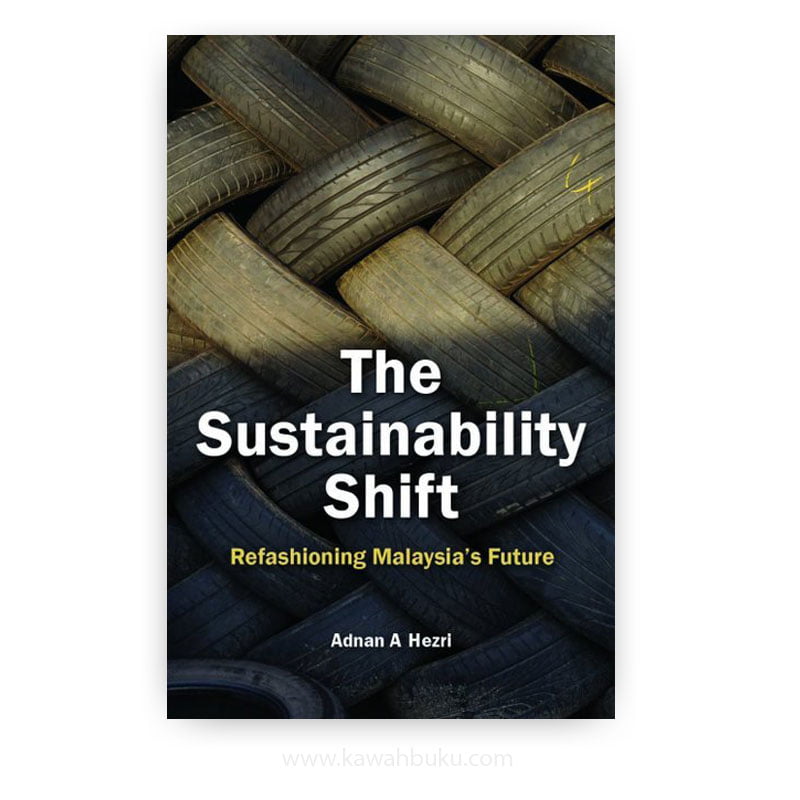
The Sustainability Shift: Refashioning Malaysia’s Future discusses the specific ecological threats facing Malaysia and the intellectual as well as practical ‘shift’ required for a more sustainable future. The book explores themes of environmental degradation, climate change and imminent ecological collapse faced by humanity today. These issues demand an urgent response from individuals, industries and national governments. Yet, in most countries, national policies are still based on fragmentary thinking and unsound science. Malaysia, a resource-rich upper-middle-income economy, is no exception.
It will certainly make a difference globally if Malaysia—home to an important tropical rainforest with mega-diverse species richness—can make a transition to sustainability. Malaysia faces a spectrum of institutional challenges as it grapples with this transition. Instead of looking at environmental problems through a compartmentalised perspective, it is essential to understand the common root causes of overarching unsustainability.
The sustainability shift essentially means that development processes must operate using the logic of sustainability principles. It provokes us to reframe our relationship with the ecosystem, rethink the character of development and redefine what constitutes social progress. This book explores possibilities and requirements for reforming institutions to enable the sustainability shift. In order to avoid uncritical adoption of the concept without realising the value-laden and complex nature of the sustainability vision, we emphasise the balance between the universality of the global sustainability agenda and Malaysia’s national characteristics, developmental stage and policy style.
For the needed policy shift to occur, changes have to take place along three trajectories: restructuring the policy framework from one that focuses on environmental problems to one which addresses sustainability; broadening the organisation-centric approach to institutional change in order to overcome the ‘silo-effect’; and changing the focus of aspirational goals to policy and programme implementation.
Over two decades after the 1992 Rio Earth Summit, advancing sustainable development from the local to the global levels remains a major challenge and responsibility. Faced with complex multi-sectoral crises, the 2015 United Nations Summit on Sustainable Development adopted Sustainable Development Goals (SDGs) to serve as a guide for the international community in implementing actions to better advance the sustainability transition. The emphasis is for the new goals to fully reflect the three dimensions of sustainable development, whereby economic, environmental and social policies are designed and implemented in a mutually reinforcing manner.
The launch of SDGs allows for nationally adapted and differentiated approaches for implementing what is seen as a common and collective responsibility. It requires governments to prepare the ground for implementation on a national scale. Yet, effective implementation of sustainable development objectives is an institutional challenge with which all governments are struggling.








Reviews
There are no reviews yet